How to Map Taxes from Salesforce to QuickBooks (Non-US Companies) Using QBSYNCMadeasy
When integrating Salesforce with QuickBooks Online, one of the most important configuration steps is tax mapping. If taxes are not configured correctly, transactions such as invoices or sales receipts may fail to sync.
For Non-US QuickBooks companies, taxes are typically applied at the transaction line item level rather than the overall transaction level. This means each line item must include the correct QuickBooks Tax Code ID.
In this guide, we explain how to configure Salesforce to QuickBooks tax mapping using QBSYNCMadeasy, including how to pass the correct QuickBooks TaxCodeRef value when creating transactions.
How Salesforce Tax Mapping Works with QuickBooks
For most Non-US QuickBooks companies, taxes are applied as follows:
- Taxes are applied per transaction line item (for example, Invoice Line Items).
- Salesforce must send the correct QuickBooks Tax Code ID when creating transactions.
- The Tax Code ID must be mapped to TaxCodeRef.value in QuickBooks.
For example:
If Opportunity Line Items in Salesforce are mapped to Invoice Line Items in QuickBooks, the tax mapping must be configured on the Opportunity Line Item level.
Key Requirements for Salesforce → QuickBooks Tax Sync
When syncing taxes from Salesforce to QuickBooks, the following rules must be followed:
- You must send the QuickBooks Tax Code ID, not the tax name.
- The Salesforce field must be mapped to TaxCodeRef.value.
- The mapping must be configured at the transaction line item level (such as Opportunity Line Item).
If the correct Tax Code ID is not passed, QuickBooks will reject the transaction.
How to Configure Salesforce to QuickBooks Tax Mapping
For Non-US QuickBooks companies, taxes must be applied to each transaction line item.
There are two supported configuration methods when using QBSYNCMadeasy.
Method 1: Tax Mapping Using a Lookup Relationship (Recommended)
This is the most scalable and flexible approach, especially if your organization manages multiple tax codes.
Step 1: Create a Custom Tax Object
Create a custom object in Salesforce, for example:
Tax__c
This object should be mapped with the QuickBooks TaxCode object in QBSYNCMadeasy.
After syncing, this object will store:
- QuickBooks Tax Code Name
- QuickBooks Tax Code ID
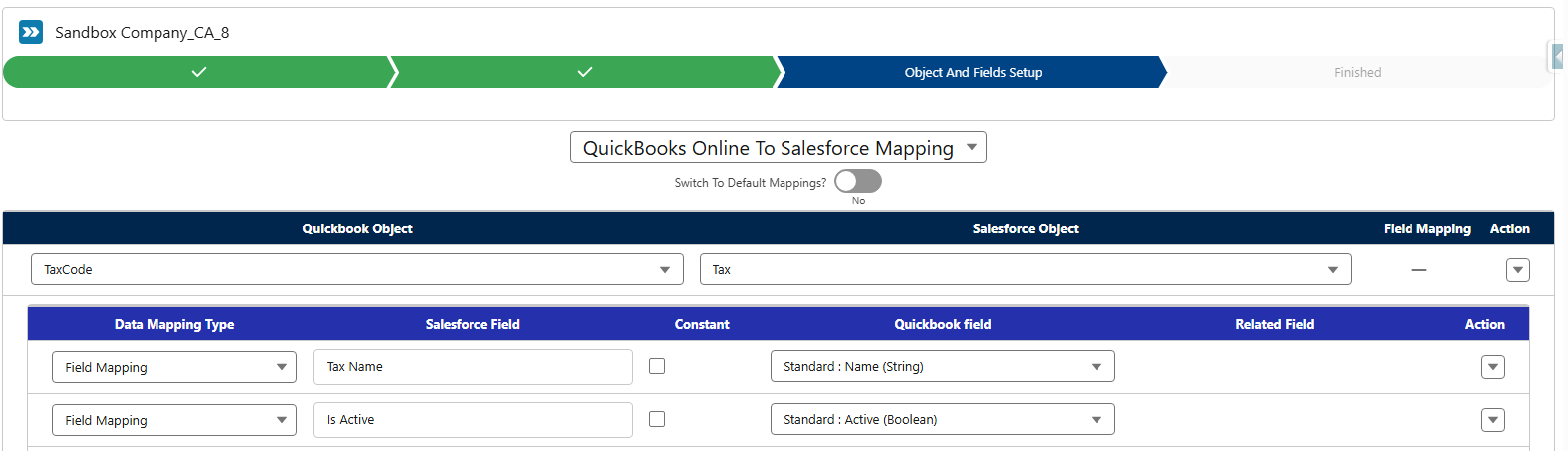
This allows Salesforce users to select tax codes that already exist in QuickBooks.
Step 2: Create a Lookup Field on Opportunity Line Item
Create a Lookup Relationship field on Opportunity Line Item.
Example field:
QB Tax
Configure the lookup to point to the custom object Tax__c.
Add this field to the Opportunity Line Item page layout so users can select the appropriate tax for each line item.
Step 3: Configure Line Item Mapping in QBSYNCMadeasy in QBSYNCMadeasy:
- Go to Line Item Mapping
- Select the lookup field (e.g., QB TaxCode)
- Map it to: TaxCodeRef.value

This ensures the QuickBooks Tax Code ID is sent correctly when creating the transaction in QuickBooks.
Method 2: Tax Mapping Using a Picklist Field
If you prefer a simpler configuration without lookup relationships, you can use a picklist field.
Step 1: Create a Picklist Field
Create a Picklist field on Opportunity Line Item.
Example values:
GST 5%
VAT 10%
Sales Tax
Step 2: Create a Formula Field
QuickBooks requires the Tax Code ID, not the tax name.
Create a Formula Field that converts the selected picklist value into the corresponding QuickBooks Tax Code ID.
Example formula logic:
CASE(
Tax_Picklist__c,
"GST 5%", "QB_TAXCODE_ID_1",
"VAT 10%", "QB_TAXCODE_ID_2",
"Sales Tax", "QB_TAXCODE_ID_3",
NULL
)
This formula returns the correct QuickBooks Tax Code ID based on the selected tax.
Step 3: Map the Formula Field in QBSYNCMadeasy:
- Go to Line Item Mapping
- Select the Formula Field
- Map it to: TaxCodeRef.value

This ensures the correct QuickBooks Tax Code ID is sent when creating the transaction in QuickBooks.
Important Note:
When configuring Salesforce QuickBooks tax mapping, keep the following points in mind: Tax mapping must always be configured at the transaction line item level. The mapped value must be the QuickBooks Tax Code ID, not the tax name. Incorrect or missing Tax Code IDs will cause transaction sync failures. Ensure tax codes already exist in QuickBooks before configuring the mapping.
Conclusion
Proper tax configuration is critical for successful Salesforce to QuickBooks integration.
For Non-US companies, taxes must be mapped at the line item level, and the correct QuickBooks Tax Code ID must be passed using TaxCodeRef.value.
By using QBSYNCMadeasy, you can configure tax mapping easily using either:
- a Lookup relationship to a QuickBooks Tax object, or
- a Picklist and Formula field approach.
Following the steps above ensures your Salesforce transactions sync correctly with QuickBooks without tax-related errors.
Was this article helpful?
That’s Great!
Thank you for your feedback
Sorry! We couldn't be helpful
Thank you for your feedback
Feedback sent
We appreciate your effort and will try to fix the article